Suffern
The ExecutionersSuffern is the small vacation town ninety miles from Harper where Sam Bowden takes his wife Carol and their young son Bucky to escape the siege that Max Cady has brought down on the Bowden family. It is the novel's fragile refuge, a place of Victorian inns and rowboats and croquet courts that stands in stark contrast to the terror closing in around the Bowden house. Yet even here, in this carefully chosen sanctuary, the threat of Cady reaches, and it is in Suffern that Carol's breakdown fully surfaces and Sam's moral crisis begins to take shape. The town functions as both a physical hiding place and a psychological pressure point, where the family's attempt to retreat from violence only forces them to confront the deeper damage the violence has done.
The Hideout and Its Selection
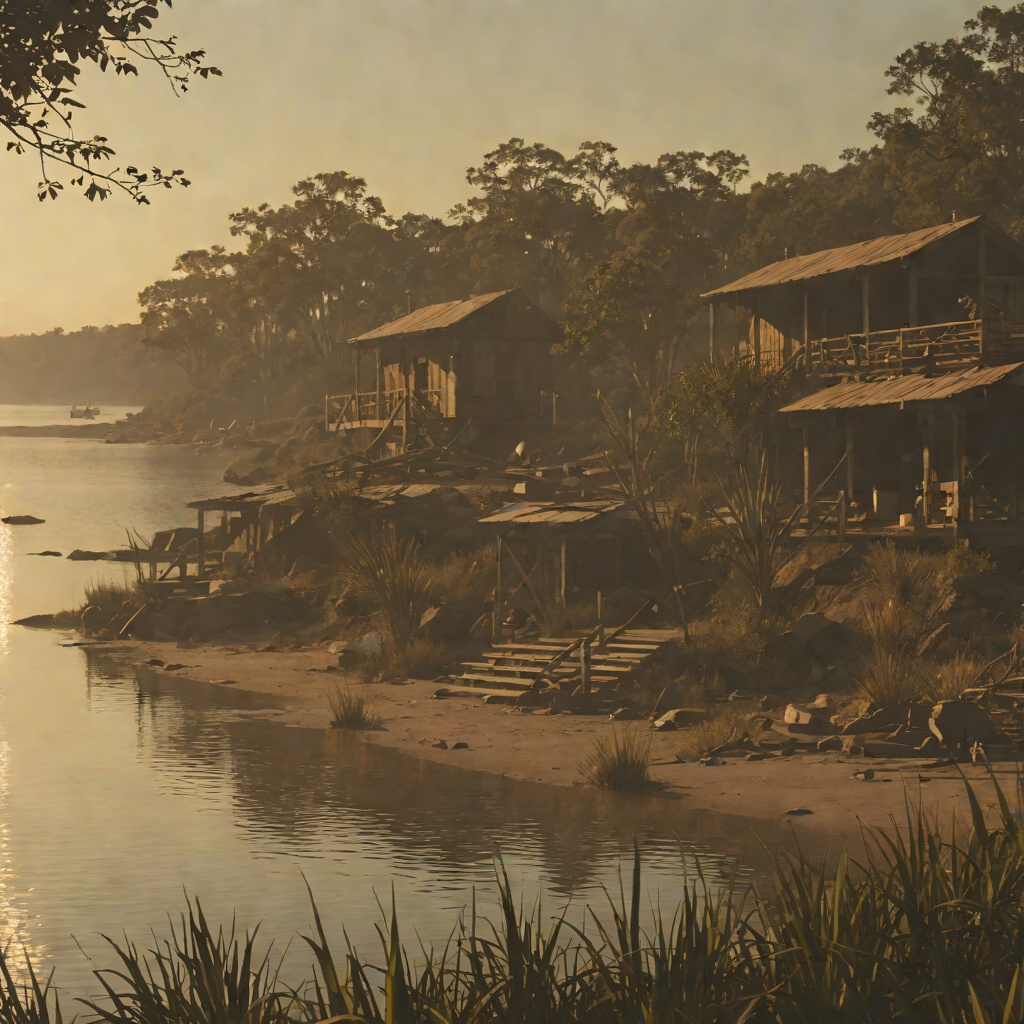
Suffern is introduced on a Friday when the Bowdens leave early and drive southeast toward the pleasant little vacation villages in the lake area. Bucky seems willing to accept the idea that Carol wants a vacation from doing all the housework, and he can come along too; it is, they tell him, the next best thing to going away to camp. They drive slowly and take side roads, arriving at the town of Suffern, ninety miles from Harper, at lunchtime. They have a good lunch in the quiet dining room of a lakeside inn called The West Wind, an old-fashioned frame building with the tall and awkward dignity of the Victorian period. A busy little cricket of a man shows them two third-floor rooms on the lakeside with connecting bath. The weekly rate is reasonable and the rooms, with maple furniture and rag rugs, are clean and cheery. The rate includes breakfasts and dinners, the use of the tiny beach, the hotel rowboats when available, the English croquet court, and the two tennis courts.
The choice of Suffern is deliberate and layered with precautions. There are other children in the hotel, and the management has never made it a policy to exclude children, but no pets, please. Even the oblique mention of Marilyn visibly saddens Bucky. It is not at all necessary, Sam decides, to use a different name; it would be theatrical, ludicrous and unnecessary. Carol says she will write directly to the office and, as an additional precaution, use envelopes not marked with the return address of The West Wind. The secrecy is meant to be absolute: the phone calls are made from the office, Sam places them himself, mail is delivered directly to the office, and he posts his letters to Carol himself.
The Logic of Safety
After completing a call to Bill Stetch, Sam goes back to Carol's room and sits at the small desk. Using a pencil and paper to help his concentration, he tries to determine through a process of logic if Cady could have found out about the Suffern hideout. He makes a short list of people who know about it. He questions Jamie and Nancy and they vow most solemnly that they have told no one, except Tommy, and Nancy is certain Tommy has told no one. He checks with the owner and by judicious use of a pair of white lies learns that there have been no inquiries about Mrs. Bowden. The possibility of Cady tailing them to Suffern is remote. He thinks back over the possible times and decides it is so remote as to be checked off entirely.
In the end he decides that Suffern is safe. With proper care it will remain safe. He knows he cannot function efficiently if he bases his moves on hunch and superstitious alarm. There has to be some starting place. Suffern is safe. So Suffern is an adequate base, a place to operate from. This logical conclusion becomes the foundation of everything that follows, yet the very need for such elaborate reasoning reveals how far the family has fallen from the secure world they once inhabited.
Carol's Breakdown and the Merry-Go-Round
On Friday and Saturday and Sunday they vegetate at Suffern. Rest and the sedative improve Carol's nerves. They swim in sunlight, and in a heavy rain, and once by moonlight. They eat hugely and sleep long hours. But the peace of the lakeside idyll cannot hold. It is here, in the quiet of the refuge, that Carol's terror finally finds words. She tells Sam about a memory from childhood, when she was about seven years old and her mother was still alive. They went to a carnival. There was a merry-go-round and her father lifted her up onto a big white horse. It was wonderful for a while. She held the brass pole and the horse went up and down. She did not know until later that her father paid the man to make it a long, long ride. After a while the faces of the people began to blur. The music seemed to get louder. When she looked out all she could see was streaks. She wanted it to stop. When she shut her eyes she felt she was going to fall off. Nobody could hear her yell. She had the feeling it was going faster and faster and the music was getting louder and louder, and she was going to be hurled off.
The merry-go-round becomes the central metaphor for her state of mind. "I want it to stop, Sam. I want it to stop going around and around. I want to stop being scared." She looks at him with naked plea. He has never felt so helpless in his life, or loved her so much. The image of the carnival ride, with its blurring faces and swelling music and the terror of being hurled off, captures the vertigo of the family's situation: the sense of being trapped on a machine that will not stop, of screaming into a void where nobody can hear, of the world spinning faster and faster toward catastrophe.
Sam's Moral Crisis
It is also at Suffern that the resolution grows in Sam's mind. Slowly, hour by hour, the resolution grows. He finds it almost impossible to face it at first. But it becomes easier and easier. The concept is so alien to his nature as to revolt him. It means a reversal of all his values, of all the things he lives by. He knows that this inner combat makes visible changes in his manner. Several times he sees Carol looking at him speculatively. He knows he seems moody and absentminded. The refuge that was meant to restore the family's equilibrium instead becomes the place where Sam decides to abandon the very principles that defined him.
In midmorning on Monday, on an oppressively hot day, he takes Carol away from her tennis game and takes her out in one of the yellow rowboats. The sky in the east has a coppery and ominous look. A moist infrequent wind would ripple the water and then die into a waiting stillness. Carol sits in the stern in white shorts and red halter and trails her fingertips in the water as he rows out into the middle of the mile-long lake. He boats the dripping oars and the boat moves smoothly along until the momentum dies. He lights two cigarettes and hands one to her. The scene is almost unbearably peaceful, a last moment of calm before the decision that will send him down the path toward the underworld errand and the gun purchase.
The Fragile World Left Behind
The contrast between Suffern and the Bowden home could not be starker. The house in Harper, thirteen miles from New Essex, sits on ten acres of farm land with elms and oaks and a line of poplars, all the front windows overlooking a far vista of gentle hills. It is more house than Sam should have purchased, but he consoles himself with the constantly increasing value of the ten acres of land. The marriage is of the very best variety, everybody is healthy, and Sam has been a partner in the law firm ever since 1948. This is the world that Cady's return shatters, the "nice little fool's paradise" that Carol mourns when she says the charm is not working any more. Suffern represents the attempt to preserve that paradise, to hide it away where the darkness cannot find it.
But the darkness follows them even here, in the form of Sam's own transformation. The refuge becomes the place where the family's values are tested and found wanting. Carol's speech about the "enormous and infantile trust that this world was made for me to be happy in" is delivered not at Suffern but in its aftermath, yet it is the Suffern interlude that teaches her this lesson. She learns that everything they have is balanced on such a delicate web of incidence and coincidence, that there are black things loose in the world, that Cady was one of them, a patch of ice on a curve can be one of them, a germ can be one of them. The lakeside town, with its Victorian dignity and its English croquet court, becomes the place where the Bowdens confront the precariousness of their entire existence.
The Return and Its Aftermath
They arrive home a little after five, put the two cars in the barn, and hurry to the house with their luggage. The rain has stopped and the trees are dripping. When they go across the lawn Sam realizes he is hurrying with his shoulders hunched, and trying to stay between Carol and the hill that rises behind the barn. He feels relief when they reach the comparative safety of the front porch. He senses that it is absurd to imagine that Cady would be sprawled up there on the wet hill, cheek against the stock, finger on the trigger, tracking them with the telescopic sight. He could not be that ready. But, on the other hand, it is equally absurd to assume that he would not be ready, and act as if he were not ready. The refuge of Suffern is over; the siege resumes. Before dark Sam goes up to the attic window in the rear of the house and carefully searches the hillside with his binoculars, wishing it were not so heavily wooded, that there were not so many huge gray boulders, so many dead falls. The peace of the lakeside is replaced by the locked doors, the gun under the pillow, the Rube Goldberg trap of pans and string blocking both stairways.
Suffern's significance lies in what it reveals about the Bowdens under pressure. It is the place where Carol's breakdown is given voice, where Sam's moral crisis reaches its decision point, and where the family's illusion of safety is finally stripped away. The town itself remains untouched by the violence, but it is forever marked in the family's memory as the place where they learned that no refuge is truly safe, that the merry-go-round cannot be stopped by simply getting off. The lakeside idyll, with its rowboats and croquet courts and Victorian inn, stands as a haunting image of the peace that the Bowdens can never fully recover.